How Do Betting Exchanges Work?
The Core Mechanism
So how do betting exchanges work? Strip away all the jargon and it comes down to one thing: you bet against other people, not against a bookmaker. That single difference changes everything about how you trade.
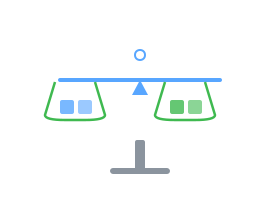
When you open an exchange, you pick a side. You either back an outcome (bet that it happens) or lay it (bet that it does not). The exchange platform hunts for another person willing to take the opposite position at your price. The moment it finds one, both stakes get locked into escrow and the bet goes live. No middleman setting the price. No house edge baked into the odds. Just two people on opposite sides of a wager.
Step-by-Step: Placing a Bet
Here is the exact process you walk through every time you use an exchange:
- Pick your market — Find the event, then drill into the specific outcome you want to trade. Football match winner, over/under goals, correct score — whatever catches your eye
- Back or lay — This is the big decision. Back if you believe the outcome hits. Lay if you think it will not. Get comfortable with both sides because the best exchange users switch between them constantly
- Set your odds and stake — You can grab the best price already sitting in the market, or you can request your own odds and wait. I almost always request my own price on pre-match markets because the patience usually pays off
- Wait for a match — The exchange scans for someone willing to take the other side at your number. On a big Premier League game, this takes a fraction of a second. On a third-division handball match, you might wait a while
- Bet locks in — Both your stake and the layer's liability sit in the exchange's escrow. Nobody can pull out now
- Settlement — The event finishes, the exchange pays the winner, and takes a small commission cut. Clean and simple
If nobody wants the other side at your price, the bet stays unmatched. You can adjust, wait, or cancel — totally up to you. That right there is the fundamental split from bookmakers, where every bet gets accepted on the spot because the house is always your counterparty.
The Order Book
Every exchange runs an order book that works almost identically to a stock exchange. You see live offers stacked at different prices, and three columns matter most:
- Back column — The prices available if you want to bet FOR an outcome happening
- Lay column — The prices available if you want to bet AGAINST an outcome happening
- Available money — The actual cash sitting behind each price, waiting to be matched
The gap between the best back price and the best lay price is the spread. A tight spread tells you the market is healthy and liquid. Premier League matches often have razor-thin spreads. Niche markets? Expect wider gaps, and factor that into your strategy before you commit any money.
Matched vs Unmatched Bets
You need to understand these three states cold, because they dictate your risk exposure at any given moment:
- Matched — Someone took the other side. Your bet is live and will settle after the event concludes
- Unmatched — Nobody has bitten yet. Your stake is reserved but you face zero risk — think of it as a pending order
- Partially matched — Half your bet found a taker, the other half is still sitting in the book
Cancel any unmatched portion whenever you want. That flexibility is what makes how lay betting works in practice so powerful, and it is the backbone of every serious exchange trading strategy.
How the Exchange Makes Money
Here is why exchanges treat you differently than bookmakers do: they do not profit when you lose. Their entire revenue comes from commission on your net winnings per market. Win 100 EUR on a Champions League match at 5% commission, and you pocket 95 EUR.
What you need to know about commission:
- You only pay it on winning bets — losers owe nothing beyond their stake
- Rates sit between 2% and 5% depending on which platform you use
- High-volume traders usually unlock discounted rates over time
- Lose a bet and you pay exactly zero commission
This fee model keeps incentives honest. The exchange profits when you trade more and win more, so they have no reason to restrict sharp accounts. Once you grasp what a betting exchange actually is, you will see why this structure gives skilled bettors a genuine edge over the traditional bookmaker setup.
In-Play Betting on Exchanges
This is where exchanges really pull ahead. In-play betting on an exchange feels more like trading a financial market than placing a bet. Odds shift in real time as the match unfolds, and you can:
- Fire off new back or lay bets at any point during the action
- Trade out of your position by taking the opposite side at different odds
- Lock in a guaranteed profit when the price moves your way — regardless of the final result
- Cut your losses early by closing a position before the whistle blows
I will be blunt: if you are not using exchanges for in-play, you are leaving money on the table. The ability to trade in and out of positions mid-event creates opportunities that no traditional bookmaker can match. Period.
Liquidity: The Key Limitation
Every exchange user hits the same wall eventually: liquidity. That is the pool of money sitting in the market, waiting to be matched against your bets. English Premier League and major horse racing meetings have deep liquidity — you can get large stakes matched without blinking. But step into niche sports, lower leagues, or obscure bet types, and the money dries up fast.
Low liquidity means partial fills or unmatched bets at the odds you want. Some experienced bettors solve this by pairing exchange accounts with broker access for guaranteed execution on sharp bookmaker lines.
One trick that works well in practice: place your orders early. Markets build volume as kick-off approaches, so dropping your bet in hours ahead at a sensible price gives it the best chance of filling completely. Check the order book depth before you size up your stake, too. Knowing how much cash sits at each price level saves you from setting expectations the market cannot deliver on.
Access Exchanges Through a Broker
If you cannot register directly with an exchange due to country restrictions, a betting broker gets you in the door. Brokers hold master accounts with the top exchanges and funnel your bets through their setup. You still get full access to back, lay, and in-play trading — just routed through a different pipe.
Beyond solving the access problem, using a reputable broker platform can actually simplify your entire workflow. One account, exchange and bookmaker access bundled together, no juggling half a dozen logins. For anyone who wants to start trading on exchanges without battling through registration headaches, working with a trusted broker is the fastest path. Everything sits under one roof, and you can focus on finding value instead of managing accounts.
Access Betting Exchanges
Trade on Betfair, Orbit & more through a single broker account
Frequently Asked Questions
What happens if my bet is not matched?
Nothing bad. Your bet just sits in the order book like an open order, waiting for someone to take the other side. You can leave it there, tweak the price, or cancel it outright. Your stake stays reserved in your account but you carry zero risk on an unmatched bet — no match means no exposure.
Can I change my odds after placing a bet?
Absolutely, as long as the bet has not been matched yet. Cancel the original, resubmit at whatever new odds you want. I do this regularly when a market moves and my initial price looks off. Once a bet is matched though, it is locked in — no take-backs.
How fast are bets matched on an exchange?
It depends entirely on the market. On a big Premier League game or a Cheltenham feature race, you will get matched in under a second. On a lower-league fixture or a niche sport, you might wait minutes, hours, or it might never match at all. The more popular the event, the faster the fill.
Related Guides
- Betting Exchanges — back to the betting exchanges overview
- What Is a Betting Exchange — foundational concepts
- Lay Betting Guide — master lay betting mechanics